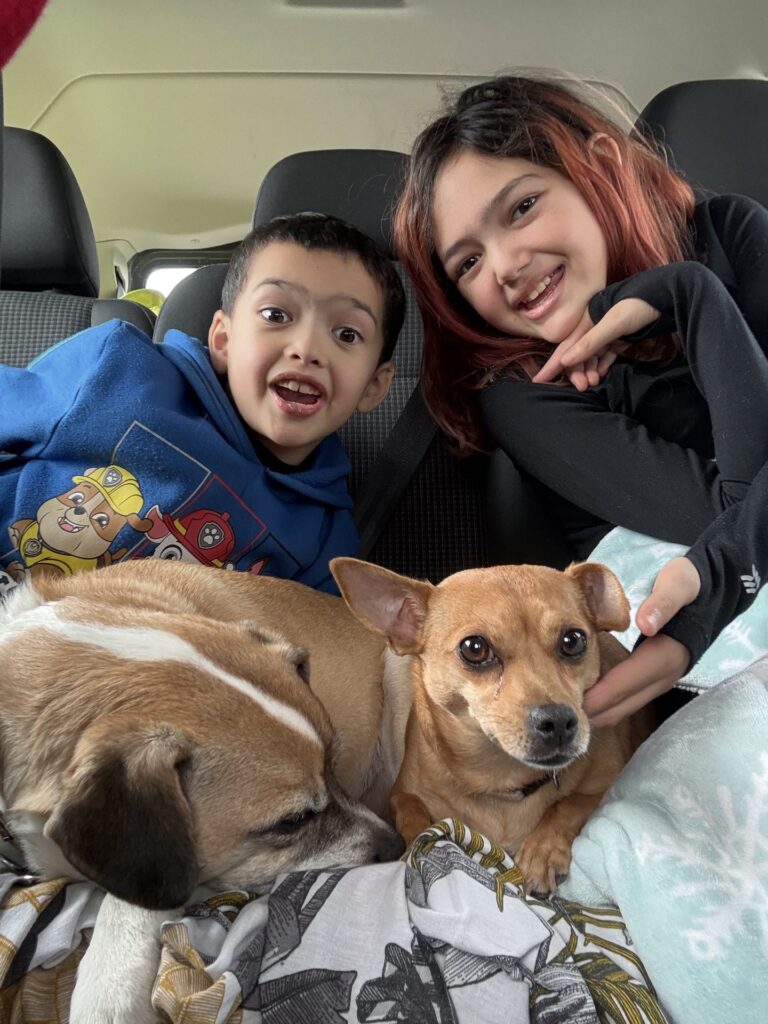
The north Oregon coast is one of the easiest pieces of the Pacific coast to do with kids. The stops are short, the beaches are huge, and you can drive a vehicle onto the sand at a few of them. We covered this stretch in December 2020 in our Class C motorhome with a preschooler, a toddler, Grandma, our nephew and four dogs, as part of our Pacific coast RV road trip with kids. This guide covers where we stopped, from the Long Beach Peninsula in Washington down to Tillamook, plus what you need to know before you go: beach driving rules, where you can and cannot sleep, sneaker waves, and dogs.
Start in Washington: Long Beach Peninsula and Cape Disappointment
If you are coming down from the Olympic Peninsula like we were, the Long Beach Peninsula is the natural lead-in. It sits on the Washington side of the Columbia River, right across from the Oregon coast.
One of our stops was Marsh’s Free Museum in the town of Long Beach. It is a family-run shop and museum of oddities at 409 Pacific Avenue, open since 1921, and its star is Jake the Alligator Man. According to the local paper, the Chinook Observer, the museum bought Jake in 1964. It is a quirky museum and shop, and the kind of free stop that breaks up a long driving day.
At the mouth of the river, Cape Disappointment State Park has the Cape Disappointment Lighthouse, North Head Lighthouse and the Lewis and Clark Interpretive Center. The Cape Disappointment light first shone in 1856. A few practical points as of 2026: Washington State Parks requires a Discover Pass for vehicles ($10 for one day, $45 for a year), the park is open 6:30 a.m. to dusk, and dogs are allowed on a leash. Big rigs should note that the parking lots at North Head, the interpretive center and Beards Hollow do not take RVs. North Head Lighthouse is open to visitors from May through September, so in winter you see it from outside.
Astoria, briefly
Astoria sits on the Oregon side of the Columbia, between Cape Disappointment and Fort Stevens. Most RV families cross the river here and keep going west to the beaches. If you have time and a parking plan for your rig, it is worth a wander, but with kids the beaches and the shipwreck at Fort Stevens are the bigger draw.
Fort Stevens State Park and the Peter Iredale shipwreck
The Peter Iredale was a British sailing ship that ran aground on Clatsop Beach on October 25, 1906, on its way to the Columbia to load wheat. No one died. What is left of the ship still sits on the sand inside Fort Stevens State Park, and you can walk the beach right up to it.
The park is big, about 4,300 acres, with a Civil War era fort site, concrete gun batteries, a lake loop trail and 15 miles of multi-use trails. Fort Stevens charges a day-use parking fee as of 2026. You can buy a one-day permit at self-serve kiosks, the visitor center or the ranger station. If you plan to hit several Oregon parks, the 12-month permit is $60 for Oregon residents and $75 for out-of-state visitors.
The wreck sits in the surf zone, so check a tide table first and read the safety section below before you let the kids run toward the water.
Sunset Beach near Warrenton: driving on the sand
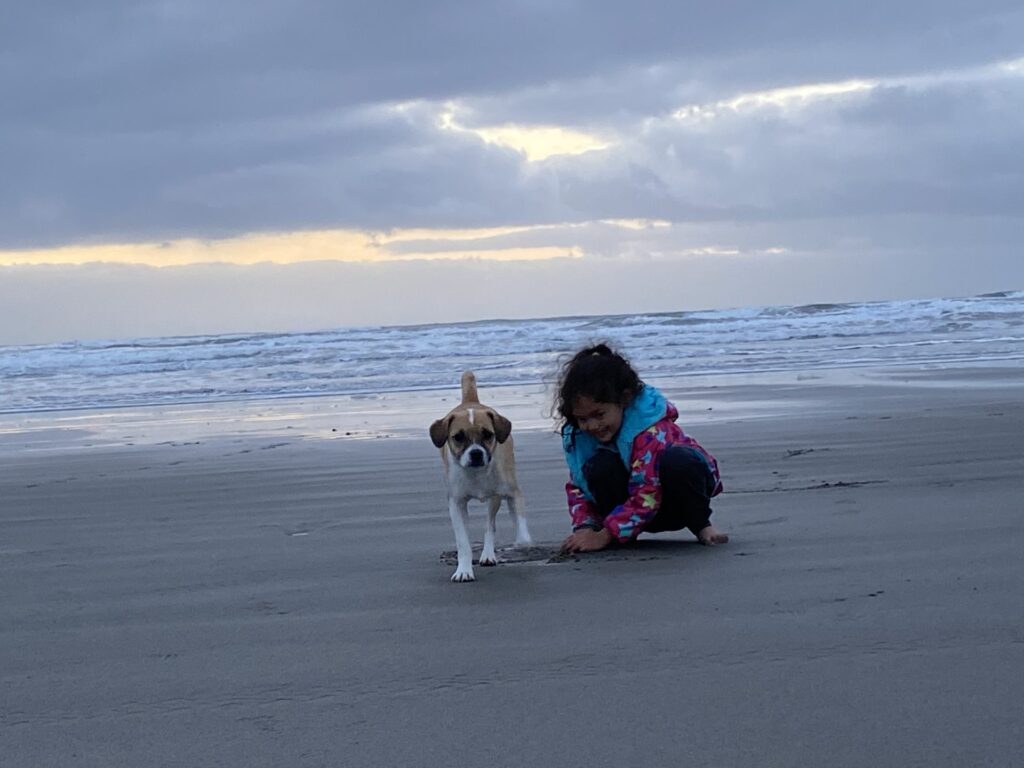
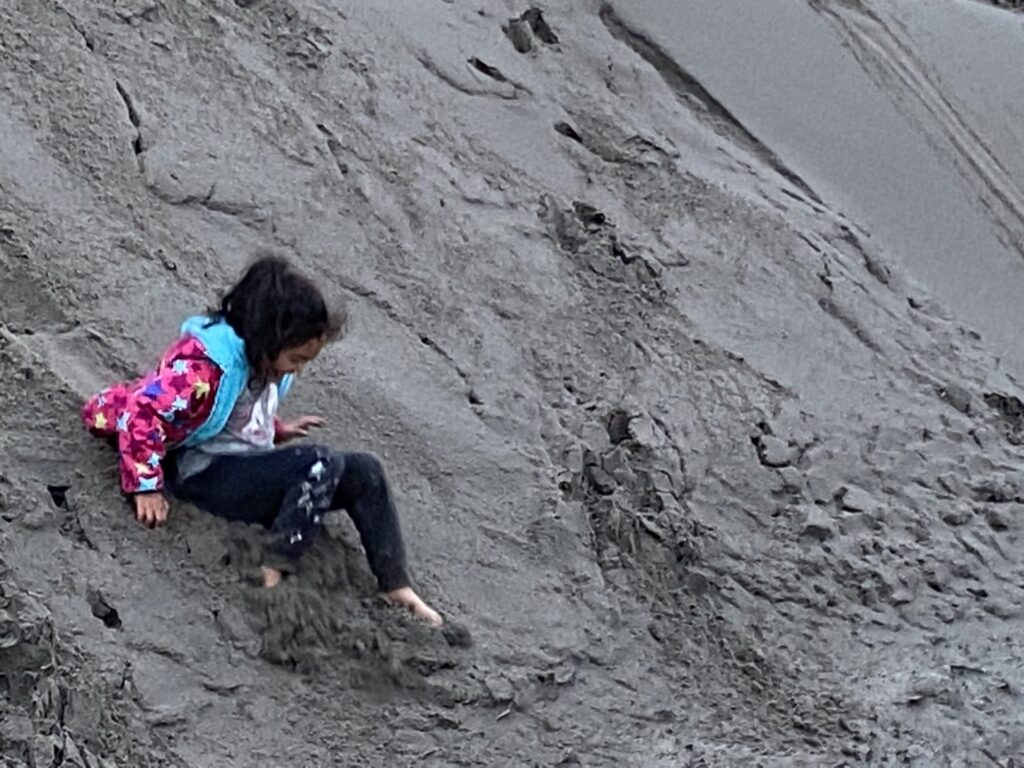
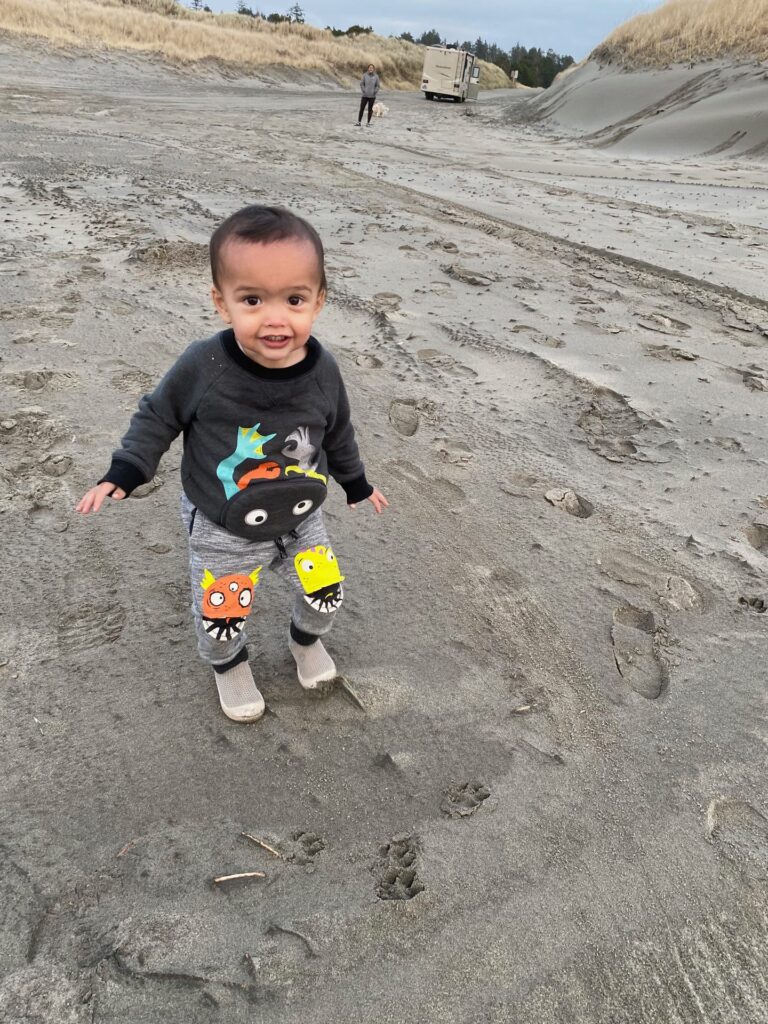
On December 22 we drove the motorhome onto the sand at Sunset Beach, south of Warrenton. The kids slid down the dunes, one of the dogs was out on the beach at sunset, and we spent the evening parked on the sand.
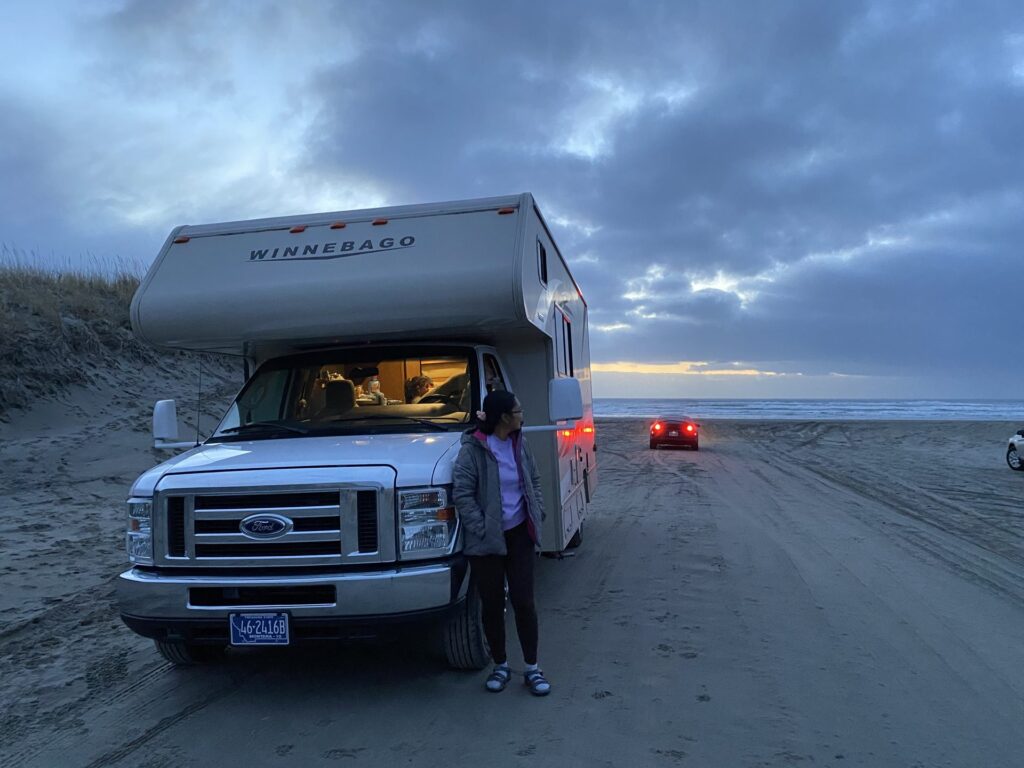
Sunset Beach State Recreation Site is one of the few places in Oregon where you can drive onto the beach. Here is how the rules work, as of 2026. Check posted signs before you go, because they can change.
Where you can drive. Oregon State Parks says vehicles may drive on the ocean shore from Gearhart north to the South Jetty of the Columbia River, with access points near Peter Iredale, Sunset Beach, Del Rey Beach and 10th Street in Gearhart. Driving is banned south of 10th Street in Gearhart.
What you can drive. Only street-legal vehicles. No motorcycles or off-highway vehicles. State Parks strongly recommends four-wheel drive. Most Class C motorhomes are not four-wheel drive, so if you try this in a motorhome, stay on firm, packed sand and do not push into soft sand.
Seasonal limits. From May 1 to September 15, vehicles are banned from noon to midnight on the stretch from the Peter Iredale access north to the South Jetty. The Columbia River beach is closed to all vehicles from March 15 to September 15. The stretch from Peter Iredale Road south to the Gearhart ramp is open to vehicles at any time under the state rule (OAR 736-024-0005).
Overnight is not allowed. This is the part to get right. Camping is prohibited on the ocean shore from the South Jetty of the Columbia River to Tillamook Head in Clatsop County, and the state rule specifically counts parking an RV so you can stay overnight as camping. That rule dates to 1999, so it applied in 2020 too. Oregon State Parks also bans overnight parking in state park day-use areas and waysides. Enjoy the sunset from the sand, then drive off the beach and head to a legal spot for the night. Fort Stevens has a year-round campground (reservations required) if you want something close.
The dunes behind the beach are soft grey sand, and the kids slid down them. Stay on open sand and off the dune grass.
Cannon Beach, if you have time
We did not stop at Cannon Beach, but plenty of families do. Haystack Rock sits on the beach there, and the rocky area around it exposed at low tide is a protected marine garden. According to Friends of Haystack Rock, collecting is closed within 300 yards of the rock, climbing the rock is not allowed, and you should keep your distance from resting seals. Note that you cannot drive on the beach here, and camping is not allowed on Cannon Beach city beaches.
Rockaway Beach dune paths
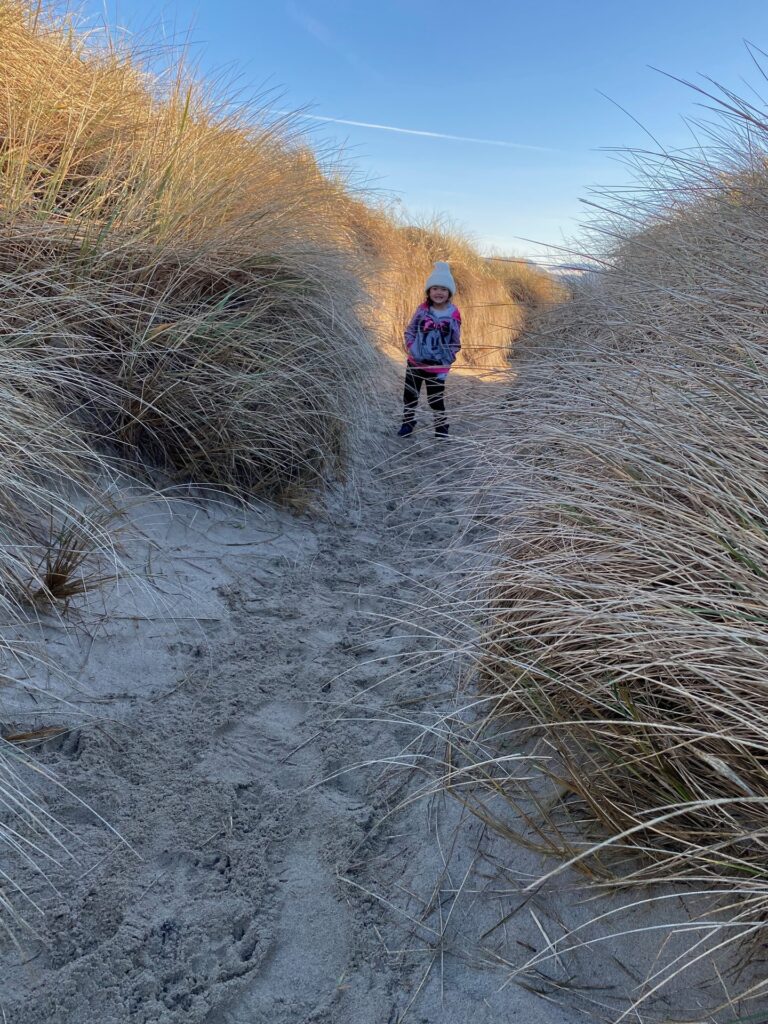
On December 23 we walked the sandy paths through the dune grass at Rockaway Beach. It is a small beach town south of Nehalem Bay with a long, open beach and many numbered access points. If you are in a motorhome, the Wayside on South 1st Avenue is the easiest stop: the Rockaway Beach Chamber of Commerce lists two RV spaces there, plus a parking lot and street parking along the railroad tracks. Many of the other access points are street parking only.
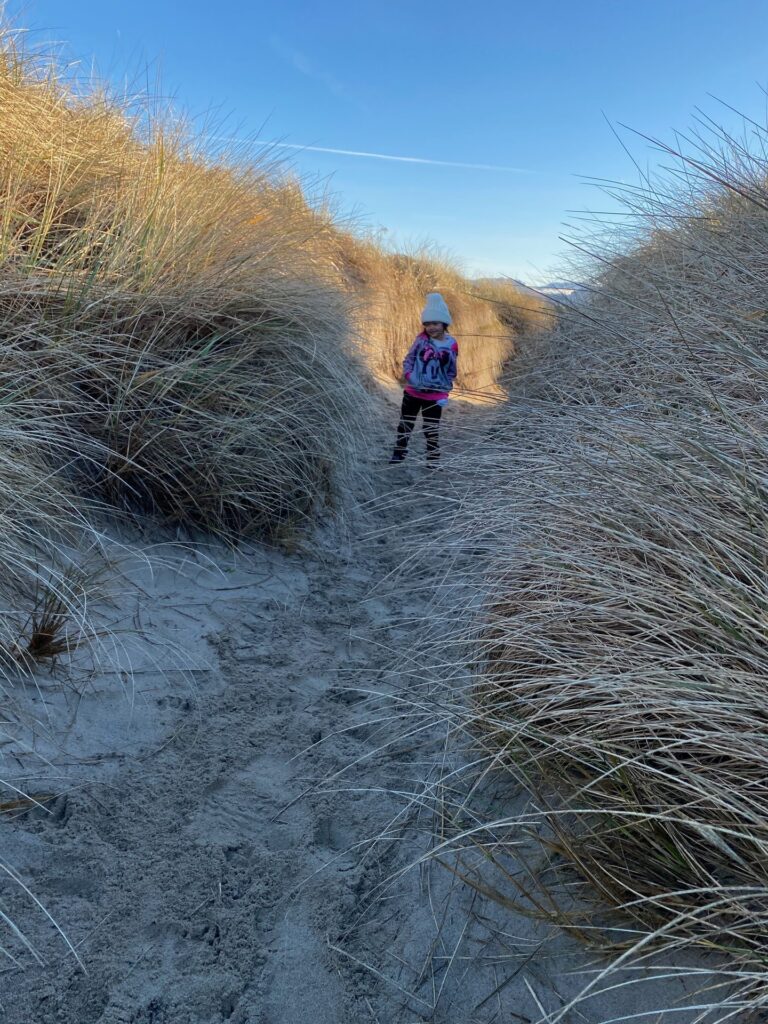
Stay on the marked paths. Some access points cross private property and are signed that way.
Nehalem Bay State Park
Nehalem Bay State Park sits on a four-mile sand spit between the ocean and the bay. You get the open beach on one side and calm bay water on the other, plus a 1.8-mile forested bike path. The park charges a day-use parking fee as of 2026, and the campground is open year-round with electrical sites and yurts.
One thing to watch with kids and dogs: from March 15 to September 15, the beach south of the day-use access trail to the north jetty is a snowy plover management area. Dogs, bikes, vehicles and kites (including drones) are not allowed there during that window. In winter that restriction does not apply, but signs at the access points have the final word.
Tillamook Creamery with kids
The Tillamook Creamery, the cheese factory on Highway 101 north of Tillamook, is an easy win for families. As of 2026 it is open daily from 10 a.m. to 6 p.m., and closed on Thanksgiving and Christmas. Entry is free, and the self-guided tour is free too, with no reservation. You walk the viewing gallery above the factory floor, try cheese at the sample counter and finish at the ice cream counter. There are paid guided tours if you want more.
For RV travelers, the Tillamook Creamery has two large lots, and RVs and oversized vehicles go in the overflow lot. Overnight RV parking is not allowed. Pets are not allowed inside (service animals are), but they are welcome in the outdoor seating area. Do not leave them in a hot or cold vehicle.
We visited on December 23. If you are traveling the same week, remember it is closed on Christmas Day.
The north Oregon coast in winter
We did this stretch in late December, and winter is a real option for families who do not mind rain gear. The beaches are quiet, and parks like Fort Stevens and Nehalem Bay keep their campgrounds open year-round. The trade-off is storms, bigger surf and short days, which makes the safety rules below more than a formality.
Sneaker waves, logs and tides: beach safety for kids
The Oregon coast is beautiful and it is not a swimming beach. Oregon State Parks’ beach safety guidance comes down to a few rules that matter even more with small kids:
Never turn your back on the ocean. Sneaker waves are unpredictable, powerful and can knock adults off their feet. They run much farther up the sand than the waves before them. Keep kids well back from the wet sand, and keep a hand on toddlers near the water.
Stay off logs. Beach logs can be waterlogged and weigh tons. State Parks warns that the ocean can pick up even the heaviest log and roll it over you. This is hard for kids, because logs look like a playground. Make it a family rule before you leave the car.
Know the tide. Check a tide table before you head out, especially for tidepools or the Peter Iredale. A rising tide can cut off your way back. Take extra care during extreme tides and storms.
Stay away from cliff bases. Rocks and chunks of bluff can fall at any time, especially under overhangs and in caves.
For what to carry on beach days, see our family first aid kit guide.
Dogs on Oregon beaches
Oregon’s beaches are generally dog friendly, which matters when you travel with four dogs like we did. The Oregon State Parks pet rules work like this, as of 2026:
- Inside state park boundaries, dogs must be on a leash no longer than six feet.
- On the ocean shore outside state parks, a leash is not required, but your dog must stay in sight and under voice control, and you must carry a leash.
- From March 15 to September 15, some beaches are closed to dogs, even on a leash, to protect nesting snowy plovers. Follow the signs at each access point.
- Pick up after your dog. Many parks have waste bag stations.
At Fort Stevens, dogs are not allowed on the Columbia River beach from March 15 to September 15. In Washington, Cape Disappointment allows leashed dogs. For packing ideas, see what to pack when traveling with a dog, and for how we handle the motorhome with kids and dogs, read RV camping with kids and dogs.
Where this fits in the trip
From Tillamook we headed inland for Christmas with family near Portland, then came back to the central coast. Further south, the redwoods were the next big highlight. Read about that stretch in Crescent City and the redwoods with kids, or go back to the full Pacific coast RV road trip with kids for the whole route.