
When to Upgrade Your Climbing Shoes: The 5-Question Test
Shoe upgrade GAS is real in climbing circles. Scroll any climbing forum long enough and someone is debating whether their two-month-old beginner shoes are already holding them back. But the opposite problem is just as common, and far less talked about.
Climbers who stay on flat, comfortable beginner shoes for years past the point where the shoe is actually limiting their performance.
So how do you know which camp you are in. After fielding this exact question from new climbers at the gym more times than we can count, we built a simple test. If you answer yes to three or more of the five questions below, it is time to upgrade.
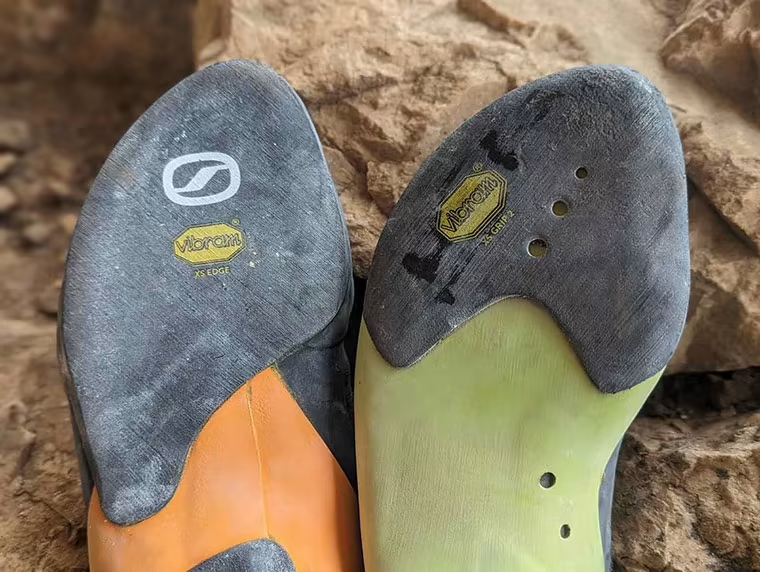
If you are just getting started and have not bought your first pair yet, our breakdown of the six things you actually need to start climbing covers shoe selection from scratch. This guide picks up where that one leaves off, for climbers who already own beginner shoes and are wondering whether to replace them.
The Five-Question Test
1. Are you curling your toes to find purchase on small footholds?
Flat, beginner shoes are built for comfort and all-day wearability, which means a relatively straight last and minimal downturn. That is great for your first months on the wall.
It becomes a problem the moment routes start demanding precision on small edges, because a flat shoe cannot transmit the same pressure through a curled toe the way a moderately downturned shoe can.
2. Do you find yourself stepping through on overhangs instead of pulling in?
Aggressive footwork on steep terrain depends on the shoe’s downturn doing some of the work for you. If your feet keep sliding off holds the moment the wall leans back, your shoe shape is part of the problem, not just your technique.
3. Have you outgrown the routes your shoes were comfortable for?
This sounds obvious, but it is the one climber miss most often, because the transition happens gradually.
The shoes that felt perfectly matched to 5.8s six months ago will feel noticeably outmatched on 5.10s and above, where smaller footholds and steeper angles are the norm rather than the exception.
4. Are you climbing three or more days a week?
Frequency matters here for a practical reason. Beginner shoes are designed with broader fit tolerances, which is exactly what you want when you are climbing once a week and your feet need recovery time between sessions. Climbers training more frequently benefit from a more precise, performance oriented fit, even if that fit is less forgiving for all day wear.
5. Do you already know what kind of climbing you want to specialize in?
Beginner shoes are intentionally generic, built to be reasonably good at everything because new climbers do not yet know what they will gravitate toward.
Once you know you are drawn to technical face climbing, steep bouldering, or long multi pitch routes, a more specialized shoe shape will outperform the generalist pair you started with.
What Actually Changes Between Flat and Moderate Shoes
The difference is not just marketing language. A flat sole distributes your weight evenly across the foot, which is comfortable but imprecise. A moderately downturned shoe shifts more pressure toward the toe, which improves precision on small holds at the cost of some all-day comfort.
This is not an upgrade in the sense of better and worse. It is a tradeoff, and the right side of that tradeoff depends entirely on what you are climbing.
Picture two specific scenarios.
On a slab route with widely spaced, large footholds, a flat beginner shoe performs just fine, because there is no precision demand the flat shoe cannot meet.
On a steep sport route with credit card sized edges, the same flat shoe will feel vague underfoot in a way that a moderate shoe simply will not.
The Shoe That Bridges Both Levels
This is exactly why we keep recommending the La Sportiva Mythos to climbers asking this question, rather than pointing them toward a more aggressive shoe outright. The Mythos sits deliberately in the middle of the spectrum.
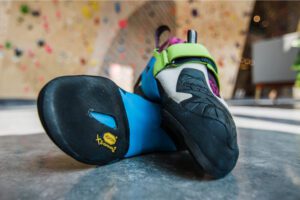
It is moderate enough to deliver real precision gains over a true beginner shoe, while staying comfortable enough to wear through long days at the crag or multiple sessions at the gym without your feet screaming by hour two.
For climbers who are not yet specialized, that middle ground is the smart move.
You get the performance upgrade the five-question test is pointing toward, without locking yourself into an aggressive, narrow shoe that only makes sense once you already know you are training for steep bouldering specifically.
The men’s and women’s Mythos differ primarily in last shape and volume, not in overall design philosophy, so the recommendation holds across both versions. If your current beginner shoes are failing the five-question test, this is the upgrade we would point you toward first, before considering anything more specialized.
Making the Call
If you answered yes to one or two of the five questions, you likely have room left in your current shoes, and spending money now would be premature. If you answered yes to three or more, the shoes are no longer growing with you, and continuing to climb in them is costing you more installed progress than a new pair would cost in dollars.
The goal is not to chase every gear upgrade the moment a new shoe catches your eye. It is to recognize the specific point where your current gear becomes the limiting factor instead of your technique, and to make one well-chosen upgrade when that point actually arrives.