The Only 6 Pieces of Gear You Actually Need to Start Climbing
When I got into climbing, I made the beginner’s classic mistake: I Googled “rock climbing gear list” and ended up reading an article that needed a spreadsheet to follow. Harnesses with five specs I didn’t understand. Carabiners rated for forces I couldn’t imagine. Shoes I’d supposedly “die without” that cost more than my first road bike.
Here’s what nobody tells you: you don’t need most of it. Not on day one. Not for the first several months. The gear industry has a vested interest in overwhelming you. I’m going to do the opposite.
Six items. That’s genuinely it. Everything else is either gym rental territory or something you earn the right to care about later.
Below is the exact list I’d hand to anyone starting out, gym climber or heading straight outdoors. I’ve kept the advice separate for each at the end, because those two paths have slightly different priorities.
1. Climbing Shoes
Your shoes are the single piece of gear that affects your climbing the most, and they’re also the one where beginners consistently overthink it. You do not need aggressive, downturned shoes. You will not use them properly, and you will be in pain all day trying.
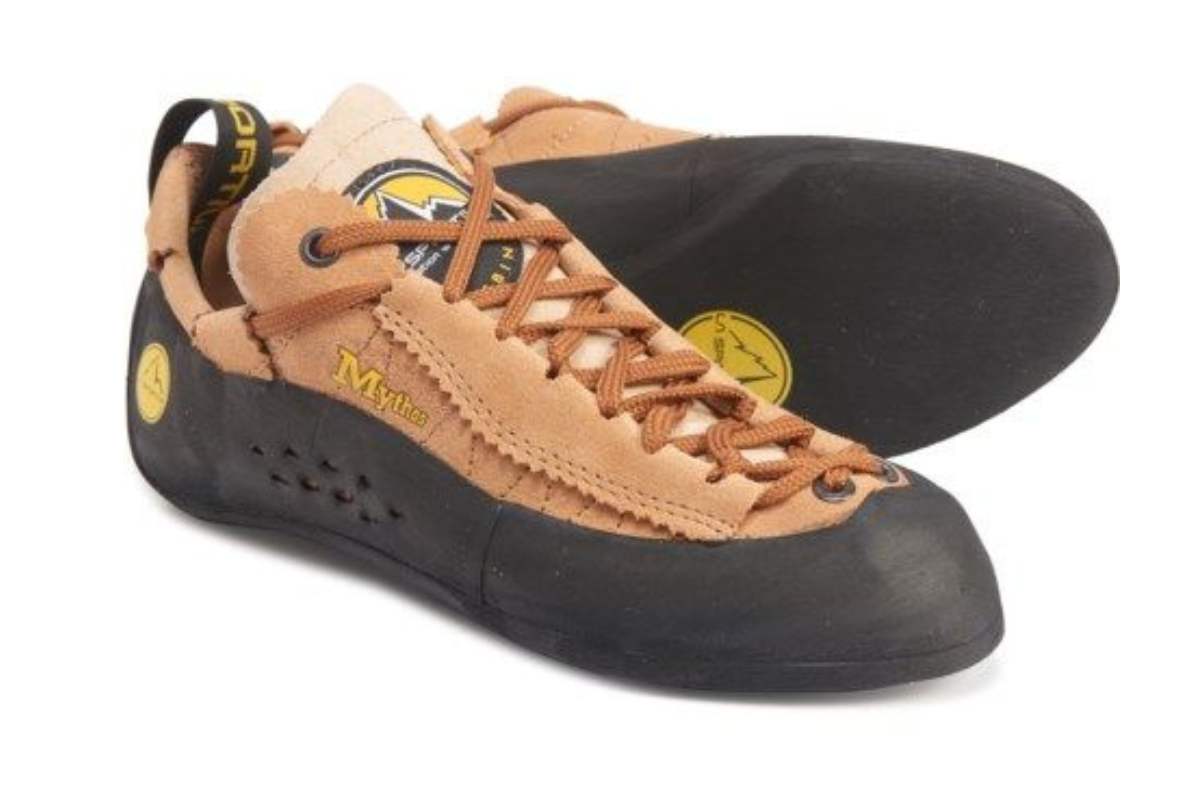
What you need is a comfortable, flat, all-day shoe with decent rubber. The La Sportiva Mythos has been the gold standard answer to this for decades. My wife has owned three pairs. Not because she keeps wearing them out because she keeps coming back to them. The lacing system is genuinely clever: it wraps from the toe box through the midfoot and locks tension across the whole foot, which means it fits almost any foot shape without hot spots.
The men’s and women’s versions are cut differently, which actually matters. Women’s feet aren’t just smaller men’s feet, and La Sportiva accounts for that.
→ La Sportiva Mythos — Men’s — Our top pick for beginner and intermediate climbers
→ La Sportiva Mythos — Women’s — 3-pair repeat buy in our house
2. Harness
If you’re gym climbing, rent one until you know you’ll stick with the sport. If you’re heading outside from the start, buy your own, borrowed harnesses are fine, but fit matters and you’ll climb better when something fits you.
For a beginner’s harness, you want: padded leg loops, adjustable legs (critical for layering), and a belay loop that’s easy to inspect. Avoid ultra-minimalist harnesses marketed at performance climbers. They save 60 grams and punish your hips on long routes.
Note: Harnesses vary significantly by brand and body type. Try before you buy when possible.
3. Chalk Bag
Chalk keeps your hands dry and your grip honest. The bag itself is simple technology a pouch, a closure, a brush loop, and a way to attach it to your harness or the wall. Most climbers use theirs for years without thinking about it.
That said, if you’re climbing with kids or introducing your family to the sport, Lilly chalk bags are in a different category. They’re shaped like characters; animals, monsters, creatures that look like they belong in a studio animation.
My kids refused plain chalk bags after seeing them, and honestly, it’s hard to argue when the octopus version is staring at you from the gear wall. Three years on, my daughter is still climbing with hers. The function is completely solid; the fun is just a bonus.
→ Lilly Chalk Bag — Character shapes — kids love them, adults use them too
4. Belay Device
A belay device is how your rope partner catches you when you fall. If you’re gym climbing, you can rent one. If you’re heading outside, you’ll need your own almost immediately. The two categories are tube-style devices (ATC and equivalents) and assisted-braking devices (GriGri being the most common).
For beginners: a standard tube-style ATC is fine and cheap. It forces you to learn the mechanics properly.
The GriGri has a reputation for being beginner-friendly because of its assisted brake, but it comes with its own misuse risks.
Either works. Learn the fundamentals with whichever you choose before developing bad habits with the other.
5. Locking Carabiner
You need exactly one to start: an HMS (pear-shaped) locker for your belay setup. That’s the large carabiner that connects your belay device to your harness. Everything else; quickdraws, slings, racks come later and is route-specific.
Don’t overthink the specs. A locking HMS from any reputable brand (Black Diamond, Petzl, Mammut) will be rated to forces you will never experience as a beginner. Weight is irrelevant at this stage.
Gate action and ease of opening one-handed are what matter. Try a few in a shop before buying if possible.
6. Rope (Outdoor Beginners Only)
If you’re gym climbing, the gym provides the rope. You do not need one. If you’re going outside and learning to lead, you need a 60m or 70m single dry-treated rope. The dry treatment is not a luxury even in good weather, rope that absorbs moisture on the rock handles poorly and wears faster.
Rope is one area where the full range of options matters.
Our gear locker covers ropes, hardware, and the rest of the rack you’ll eventually build worth bookmarking for when you’re ready to go deeper.
→ Travel Gear Locker — Climbing Hardware & Rope — Curated climbing gear across all categories
Gym Climber vs Outdoor Beginner: What Changes?
If you’re starting at a gym
Buy shoes and a chalk bag immediately. Rent everything else until you’ve climbed at least a dozen sessions. You’ll know by then if you’re hooked and whether you lean toward top-rope, lead, or bouldering which changes what gear makes sense to own.
If you’re going straight outdoors
Add a harness, belay device, HMS locker, and a rope to your list from day one. You cannot lend your way through an outdoor climbing day the same way you can at a gym. Get the full six before your first crag trip.
Six items. Shoes, chalk bag, harness, belay device, locker, rope (if outdoor). Everything else is noise until you’ve spent real time on the wall and figured out which direction you want to climb.
The goal on day one isn’t to have the right gear stack. It’s to fall in love with the movement. Gear follows naturally once you do.