
Most “kid-friendly” crag lists start and end with easy routes. That is the wrong place to start. A cliff can be full of 5.4s and still make for a miserable family day. The approach crosses loose scree. The base is a narrow ledge. The wall bakes in the sun until 4 p.m. There is nowhere for a four-year-old to sit without wandering toward a drop.
The reverse is also true. A small, unglamorous crag with a handful of moderate routes can be a perfect day out if the walk is short, the ground is flat, and there is shade and room to play.
So when we call a crag kid-friendly at NomadicClan, we mean the whole day works for a family. Not just the climbing. This guide explains the test we use, so you can apply it to any crag, anywhere.
Start with the approach
The walk from the car to the rock decides more family days than anything on the wall. Ten minutes on a clear trail is a very different proposition from forty minutes uphill with a toddler on your back and a rope on your partner’s.
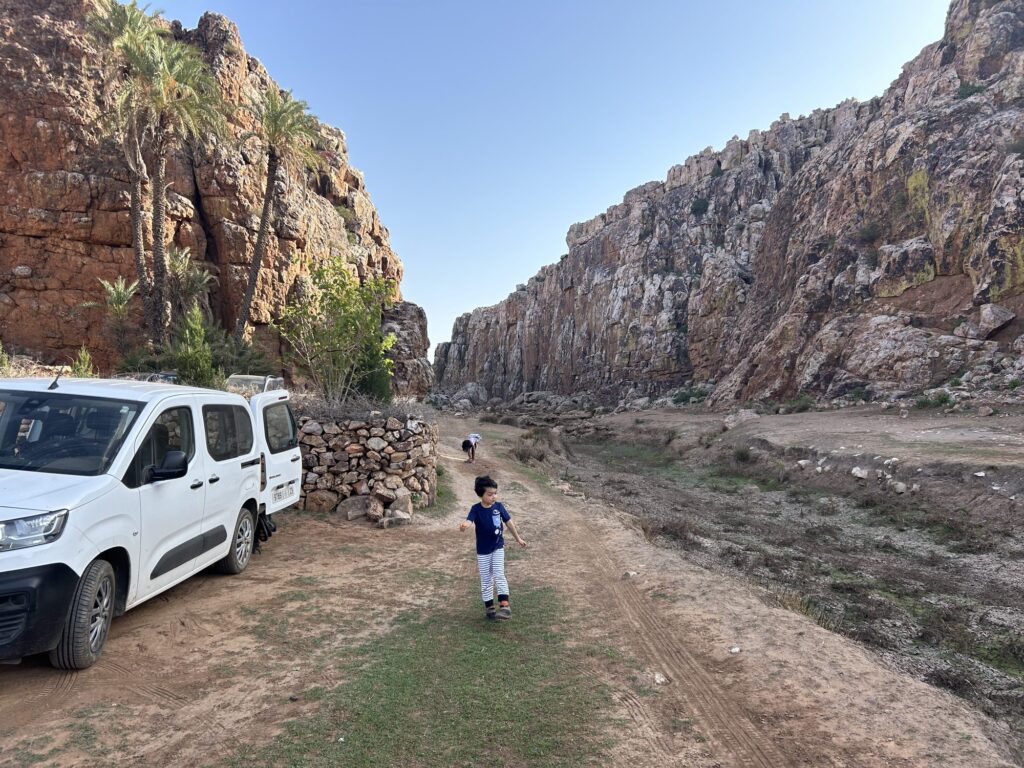
Look at three things. First, time. Guidebook approach times assume adults with light packs. With small kids, double it. Second, terrain. Talus, scrambling, fixed lines and steep switchbacks all slow children down and add fall risk. Third, what you have to carry. A family brings food, water, layers, a first aid kit and often a child carrier on top of the climbing gear.
If the approach is long, hot or exposed, the Access Fund’s advice is simple: reconsider your plans. Saving that crag for a year or two is not a failure.
The base matters more than the routes
Parents spend most of a crag day on the ground, not on the wall. That makes the base of the cliff the single most important feature to check.
A good family base is flat and wide enough that a belayer, a waiting climber and a child can all fit without crowding. It has no drop-offs, no ledges and no steep slope running away from the wall. It is also stable underfoot. Loose blocks and scree are hard on small ankles.
Ask yourself one practical question: where will the youngest child sit while I belay? If you cannot picture that spot, the crag is probably not ready for your family.
Look up, too
Rockfall is part of climbing outdoors. Climbers above can knock off loose rock. Ropes pulled through can dislodge stones. Weather loosens holds over time. Children at the base are not exempt.
That is why guide services such as the Alpine Institute recommend that kids wear a climbing helmet from the moment they arrive at the crag until the moment they leave, not only when they climb. A bike helmet is not the same thing. Climbing helmets are designed for impacts from above.
When you choose a spot for the kids to hang out, set it back from the foot of the wall and out of the line of any route being climbed. The Access Fund calls this a safe kid zone: out of the drop zone and away from other hazards.
Routes that fit the kids you actually have
Once the approach and base pass, then look at the climbing.
For young beginners, the useful mix is short, low-angled routes at easy grades. The Alpine Institute suggests routes roughly in the 5.0 to 5.6 range and under about 50 feet for children. Slabs and lower-angle walls with big holds work better than steep, crimpy rock.
Top-rope access matters as much as grade. Can an adult walk to the top safely to build an anchor? Are there fixed anchors at a reasonable height? A crag where every route has to be led first is a harder family day.
Older kids change the picture. A twelve-year-old who climbs in a gym twice a week wants routes that challenge them. A good family crag for teenagers has range: a few moderates for warming up and something harder to project.
What keeps kids engaged is rarely the grade. Short routes they can finish, quick turns, and the freedom to come down whenever they want matter more than reaching the top.
Shade, sun and the time of day
Children overheat and chill faster than adults. They also stop having fun faster.
Check which way the wall faces. In the Northern Hemisphere, south-facing rock gets the most sun and north-facing rock stays shadier. The reverse is true south of the equator. Many guidebooks and Mountain Project area pages list aspect and when a wall goes into shade.
Then match it to the season. A sunny south-facing crag can be ideal on a cold spring morning and dangerous on a July afternoon. The kid zone needs shade too, not just the belay.
Water, toilets and the boring logistics
These are the questions experienced climbing parents ask first.
Is there drinking water at the parking area, or do you carry everything? Is there a toilet at the trailhead? If not, what is the local rule? Some areas now ask visitors to pack out human waste in bags. Elsewhere, Leave No Trace guidance is a cathole at least 200 feet (about 60 meters) from water, camps and trails. With toddlers in diapers, plan to pack everything out regardless.
Bring more food, water and layers than you think you need. That line from the Access Fund is worth taking literally.
Hazards that are easy to miss
A crag can pass every test above and still have one problem that rules it out for young kids. Scan for these:
- a road, railway or busy parking area close to the base
- open water, a river or a pool below the crag
- cliff edges at the top that are easy to walk to
- poison ivy, nettles or thorny scrub around the base
- snakes, ticks or stinging insects in season
- other users nearby, such as mountain bikers on a shared trail
None of these is automatically a deal-breaker. A river can be part of the fun with older kids and close supervision. But you should know about each one before you arrive.
Crowds, space and other climbers
A family takes up more room than a pair of climbers. Packs, a picnic blanket, toys and a child carrier spread out fast.
Popular crags on a weekend can make that hard. You end up squeezed between groups, and a crying toddler echoes off the wall. The Access Fund’s advice is to look for crags with room at the base and fewer crowds, and to stay aware of noise and “toy sprawl.”
Midweek visits, early starts and less famous walls usually solve this. They also tend to make the day calmer for everyone.
Dogs, strollers and the rest of the family
Not everyone in a family climbs. Grandparents, a baby, a teenager who would rather read, the dog. A good family crag has something for them too.
Check whether dogs are allowed and must be leashed. Check whether the approach could take a sturdy stroller or whether it is carrier-only. Look for a picnic spot, a short nature walk or a stream nearby. And know your plan B: a swimming spot, a playground or a town for ice cream if the weather turns or the kids are done by 11 a.m.
Match the crag to your kids’ ages
The same crag can be perfect at one age and wrong at another.
With babies and toddlers, flat ground, shade, a short approach and a safe play area matter most. The climbing is almost secondary. Small children also need a full-body harness. Most do not yet have defined hips, so a sit harness can slip. Harness maker Edelrid recommends full-body harnesses for children up to about 40 kg, moving to a sit harness once the hips have developed. Our family climbing gear guide covers what to buy.
With elementary-age kids, short top-ropes, bouldering and lots of variety keep the day going. With teenagers, route quality and challenge start to matter as much as logistics.
The NomadicClan kid-crag test
Every crag guide on NomadicClan runs through the same questions. You can use them for any crag you are considering.
- How long is the approach with kids, and what is the terrain?
- Is the base flat, stable and roomy, with a safe kid zone away from the wall?
- Is there rockfall risk from above, and where can kids sit out of it?
- Are there short, easy routes, and can an adult set top-ropes safely?
- When is the wall in sun or shade in the season you plan to go?
- Are there water and toilets, and what are the local waste rules?
- Are there roads, water, edges, plants or animals to watch for?
- How busy does it get, and is there room for a family?
- Are dogs allowed? Is the approach stroller- or carrier-only?
- What is there to do nearby when climbing is over?
We do not turn these into a score. A single number hides the one thing that matters for your family. Instead, each crag guide explains which of these a crag does well and where it falls short, so you can decide.
Ready to look at real places? Browse our kid-friendly climbing destinations, see what to pack for a family day at the crag, and read how to choose your first outdoor climbing area with kids before you go.