The Ultimate Seward Highway Road Trip from Anchorage to Seward with Epic Stops Wildlife and Secrets
We drove the Seward Highway at the height of Alaska’s summer. What we found along the way caught us completely off guard, and we’ve been telling people about it ever since.
Have you ever taken a seward highway road trip and pulled over three times in the first ten miles because you couldn’t stop staring? That’s what this road does to people.
One hundred and twenty-seven miles. That’s all that separates Anchorage from the coastal fishing town of Seward. But call it a “short drive” and the locals will laugh at you. On one side of the road, the Chugach Mountains are stacked so high they block out the sky. On the other, the Turnagain Arm churns with tidal bores that have been known to strand people in the mud. This is not a highway you scroll through. You feel every mile of it.
The Experience
Moose crossing the road ahead. Beluga whales surfacing in an arm of the sea. A glacier the color of Caribbean water sitting at the end of a forest trail. Serpentine hills dropping into rivers you want to fish on the spot.
We spent a full week on this route, drove it in both directions, and still found things we missed the first time. Below is everything that actually matters, told straight.

Everything you need to plan the ultimate seward highway road trip, from the moment you leave Anchorage to the last halibut charter out of Seward, is laid out right here.
If one road trip has you hungry for more, our complete guide to the greatest road trips across the United States covers seven routes worth rearranging your whole year for.
One thing before you go: past Girdwood, cell service is basically a rumor. The mudflats at Turnagain Arm look walkable. They are not. People have died out there when the bore tide came in. Bear encounters in Kenai are not theoretical. Pick up an Airalo travel eSIM, download your offline maps in Anchorage, and take the safety signs seriously.
Route Overview at a Glance
| Stop | Distance from Anchorage | Drive Time | Top Highlight |
| Anchorage | Start | Start | Alaska Native Heritage Center |
| Girdwood | 40 miles | 45 minutes | Crow Creek Gold Mine |
| Turnagain Arm | 50 miles | 1 hour | Beluga Whale Spotting |
| Portage Valley | 65 miles | 1 hr 20 min | Portage Glacier Cruise |
| Kenai Peninsula | 90 miles | 1 hr 45 min | Cooper Landing Rafting and Kenai Wildlife Refuge |
| Moose Pass | 97 miles | 2 hours | Trail Gateway Village |
| Seward | 127 miles | 2 hrs 45 min | Kenai Fjords National Park |
Your Seward Highway Road Trip Starts Here: What to Do in Anchorage Before You Hit the Road
Most people wake up in Anchorage, throw their bags in the car, and bolt south before breakfast. We get it. The highway is calling.
But here’s the thing: Anchorage is doing a lot of quiet, interesting work that you’ll appreciate more once you’re deep in the wilderness. Skip it and the rest of the trip is just pretty scenery. Spend a day here and everything downstream gets context.
This is the largest city in Alaska.
Almost 40% of the state’s population lives here. And yet it still backs up against moose habitat, glacier trails, and the Cook Inlet. That’s a strange and genuinely exciting combination that nowhere else in the country pulls off.
We spent a full night here before hitting the road, and the Alaska Native Heritage Center in particular changed how we read every roadside marker and cultural reference all the way down to Moose Pass. That’s the kind of thing you can’t Google your way into. You have to show up.
Don’t wing the hotel situation. Summer books up fast. Check hotel availability and rates in Anchorage here well before your trip.
Top Things to Do in Anchorage Before Your Road Trip
- Anchorage Museum: A proper introduction to Alaska’s indigenous culture, modern history, and scientific landscape. If you go nowhere else in the city, go here.
- Tony Knowles Coastal Trail: Eleven miles of flat, easy trail hugging the edge of the Cook Inlet with the Chugach Mountains filling up the view behind you. Run it, bike it, or just walk and take photos.
- Alaska Wildlife Conservation Center: Where orphaned moose, bison, bears, and musk oxen are rehabbed and given space to live. It’s more moving than you expect.
- Alaska Native Heritage Center: Live performances, traditional structures, and hands-on cultural programming. Genuinely one of the best cultural experiences in the state.
- Glacier Cruise: A half-day on the water with sea lions, otters, icebergs, and beluga whales before you even leave the city. A strong opener for what’s ahead.
Preparations for the Drive South
Tank up before you leave. Girdwood has a gas station about 40 miles south, but in peak summer it runs queues. After that, your options thin out considerably until the Sterling Highway junction.
Offline maps are not optional on this route. Buy snacks in Anchorage too. You’ll be pulling over constantly and you will not want to rush stops because you’re hungry and the next town is 30 miles out.
Anchorage to Girdwood: 40 miles / 45 minutes
Forty miles south, a mountain town with a gold rush past and Alaska’s most serious ski resort is sitting there ready to eat your whole afternoon. Let it.
Girdwood: Alaska’s Mountain Playground and Your First Epic Stop

Girdwood shouldn’t work as well as it does. It’s a tiny mountain town named after a gold miner, sitting 40 miles south of a major city, operating one of the most serious ski resorts in North America. And yet here it is, entirely charming and wildly underrated.
The anchor is Alyeska Resort, which holds the title of the longest continuous double black diamond ski run in North America. In winter, this place fills up with skiers who know what they’re doing. In summer, Mount Alyeska becomes hiking and biking territory, and the tram ride up 2,300 feet is one of those experiences that makes the whole trip feel cinematic.
At the top you get unobstructed views of the Turnagain Arm and the surrounding glacier fields. There’s a restaurant up there. The food is good. The view is unreasonable.
What You Get
Honestly, the thing we talk about most from Girdwood is the Crow Creek Mine. It’s been operating since 1896 when James Girdwood struck gold in the Turnagain Arm area and put this little valley on the map. The mine is still active. You can pan in it.
The Crow Creek Mine gold panning experience is far more immersive than it looks on paper, and your kids will absolutely lose their minds over it.
We showed up half-expecting a theme park version of mining history. What we got was genuine creek panning with knowledgeable guides, real technique instruction, and a creek that actually yields color if you work it properly. We were there two hours. We could have stayed three. Wear clothes that can get muddy.
Girdwood to Turnagain Arm: 10 miles / 15 minutes
The next stretch of road is where Alaska stops being scenic and starts being genuinely wild. The coastline gets dramatic, the tides get extreme, and if your timing is right, you’ll pull over to watch beluga whales moving through the water below the highway.
Turnagain Arm: Beluga Whales Tidal Bores and the Most Dramatic Coastal Drive in Alaska
The name alone tells you something went wrong here for someone. Explorer James Cook sailed into this inlet looking for the Northwest Passage and had to turn around. Twice. So they named it Turnagain Arm, and the geography has been humbling travelers ever since.
This is a fjord. A real one. Turnagain Arm is a long, narrow slice of sea carved between high cliffs, fed by glacial melt, and ruled by tidal patterns that make it one of the most dramatic coastal drives on the continent.
The stretch of highway along it begins at Potter Marsh and runs all the way to the start of the Kenai Peninsula. You’ll want to stop multiple times. Budget for it.
Potter Marsh: Alaska’s Best Roadside Wildlife Viewing Spot
Up to 130 species of birds pass through Potter Marsh depending on the season. There’s a wooden boardwalk that takes you right out into the middle of the wetland.
In summer, the Turnagain Arm Trail and McHugh Creek Waterfall open up nearby. In winter, the marsh freezes solid enough to skate on. Not many people know that last part.
Beluga Point: Where to Watch for Whales on the Seward Highway
Pull over at Beluga Point and look down at the water. In fall, beluga whales come in here to chase salmon and hooligan runs. It’s one of those moments that makes you feel like you’re watching something not meant for human eyes.
If you want the best shot at seeing belugas at Beluga Point, arrive 3 to 4 hours before Anchorage high tide. That is the window most guides don’t tell you about.
First time we visited, we showed up at low tide and stared at mudflats for twenty minutes. Second time, we planned around the tide table and watched a pod of belugas move through in broad daylight. Check the tide schedule the night before and build your drive timing around this single detail.
And this is not a small thing: do not step onto those mudflats. The glacial silt behaves like quicksand and the bore tide moves in faster than it looks. People have been caught out there. Stay on the viewing area.
The Bird Creek fishing hole nearby is worth a stop too if salmon fishing is on your list.
Turnagain Arm to Portage Valley: 15 miles / 20 minutes
A few miles past Beluga Point, the road leads you into a valley that used to be a thriving village before the earth swallowed it whole. What’s there now is eerie, beautiful, and absolutely worth the detour.
Portage Valley: Glaciers Ghost Towns and Alaska’s Most Underrated Hidden Gem

In 1964, the Good Friday Earthquake hit Alaska with a magnitude of 9.2. It remains the second most powerful earthquake ever recorded. Portage didn’t survive it. The land dropped, saltwater flooded the town, and everything died. What’s left are the ghost frames of buildings standing in dead trees, surrounded by water. It’s haunting in the most honest way.
These days, the valley draws people for its glacier, not its history. But both are worth your time.
The Alaska Wildlife Conservation Center sits at the valley entrance. Rescued and orphaned animals live here: moose, bears, elk, bison. You can drive the 1.5-mile loop or book a guided tour. Either way, the animals are close and the experience is real.
Five minutes further in, the Portage Glacier waits inside the Chugach National Forest. To reach the glacier face, you board the Portage Glacier Cruise at Portage Lake. It’s a proper boat trip right up to the ice. Worth every minute.
The Trail of Blue Ice is genuinely one of the most underrated walks in Alaska, and almost nobody in the tour groups ever takes it.
While the crowds queue for the cruise, the trail is empty. Five miles of flat gravel winding past Byron, Middle, and Explorer glaciers, plus a salmon viewing platform mid-trail. We walked it on a Tuesday morning and saw exactly four other people. If your legs are up for it, skip the boat and walk the ice instead.
Portage Valley to Kenai Peninsula: 25 miles / 30 minutes
The road out of Portage climbs onto the Kenai Peninsula, and suddenly every adventure you’ve ever wanted to take is stacked right in front of you. The hard part is not trying to do all of them in one day.
Kenai Peninsula: Adventure Capital of the Seward Highway Road Trip
This is where the seward highway road trip stops being a drive and becomes something you’ll talk about for years. The Kenai Peninsula is where you run out of days.
The Kenai Peninsula is home of the Kenaitze Indian Tribe, who’ve lived here long before anyone called it Alaska’s Playground.
They call it Alaska’s Playground because it genuinely is one. Rugged mountains, glacier-fed rivers, dense forests, and wildlife so abundant it stops feeling exceptional after a while. The peninsula holds the Kenai Mountains, the Harding Icefield, and glaciers like the Exit Glacier that you can reach by road.
Best Outdoor Adventures on the Kenai Peninsula
Halibut fishing in the Cook Inlet and Kachemak Bay. Salmon fishing in the Kenai and Russian Rivers. Whitewater on the Kenai and Sixmile Rivers. Hiking up into the Kenai Mountains toward the ice-blue Exit Glacier. If you want to understand the region’s Russian history, pull over at Ninilchik, a small town with a deeply layered past and a music festival that draws people from across the state.
Cooper Landing is the kind of place that swallows your itinerary whole if you are not careful, and we mean that as the highest possible compliment.
We gave it two hours. We stayed half a day. The Upper Kenai scenic float is gentle enough for kids as young as five, with enough scenery to keep adults completely absorbed. The salmon fishing here in summer is genuinely world-class, and Cooper Landing itself has the unhurried energy of a place that knows it doesn’t need to try hard. Add buffer time here. You’ll thank yourself.
Kenai National Wildlife Refuge: Bears Moose and Untamed Alaska
Two million acres of tundra, mountains, lakes, and boreal forest, managed entirely for the wildlife that lives there. The Kenai National Wildlife Refuge is where you go to see bears and moose without having to work for it.
Stop at Tern Lake on your way through. It’s a consistent wildlife photography location and genuinely one of the calmer, more beautiful pauses on the whole peninsula.



Kenai Fjords National Park: Glaciers Whales and Alaska at Its Wildest
Half of Kenai Fjords National Park’s 600,000 acres is covered in snow and ice year-round. The Harding Icefield alone spans more than 700 square miles. It’s one of the largest non-polar icefields on the planet.
The top draw is the tidewater glacier cruise into Aialik Bay and Northwestern Fjord, where fin whales, humpbacks, orcas, sea otters, and Steller sea lions are all in the same frame at once.
The Exit Glacier is accessible by road and completely free to visit. More on that when we get to Seward.
Kenai Peninsula to Moose Pass: 50 miles / 55 minutes
Just before Seward, the highway passes through one of Alaska’s smallest and most overlooked communities. Blink and you’ll miss it. Don’t blink.
Moose Pass: Authentic Alaskan Village Life Just Before Seward
Three hundred people. One general store. A lake so still in the morning it looks like a mirror dropped in the middle of the mountains.
That’s Moose Pass. Sitting on the shores of Upper Trail Lake, it’s the last real community before Seward, and it carries an honesty that the bigger towns don’t quite manage.
It’s also the trailhead for some of the best hiking on the peninsula. The Johnson Pass Trail, the Iditarod Trail, the Carter Lake Trail, and the Lost Lake Trail all originate here, each offering a completely different face of Alaskan backcountry.
If you have extra time and a tent, this is where you use both.
Moose Pass to Seward: 30 miles / 35 minutes
The last 30 miles into Seward are some of the most cinematic driving on the entire route. The mountains open up, the bay appears, and then you’re there, at the edge of the continent, wondering why it took you this long to come.
Seward: Fjords Glaciers Wildlife and the Perfect End to Your Alaska Road Trip
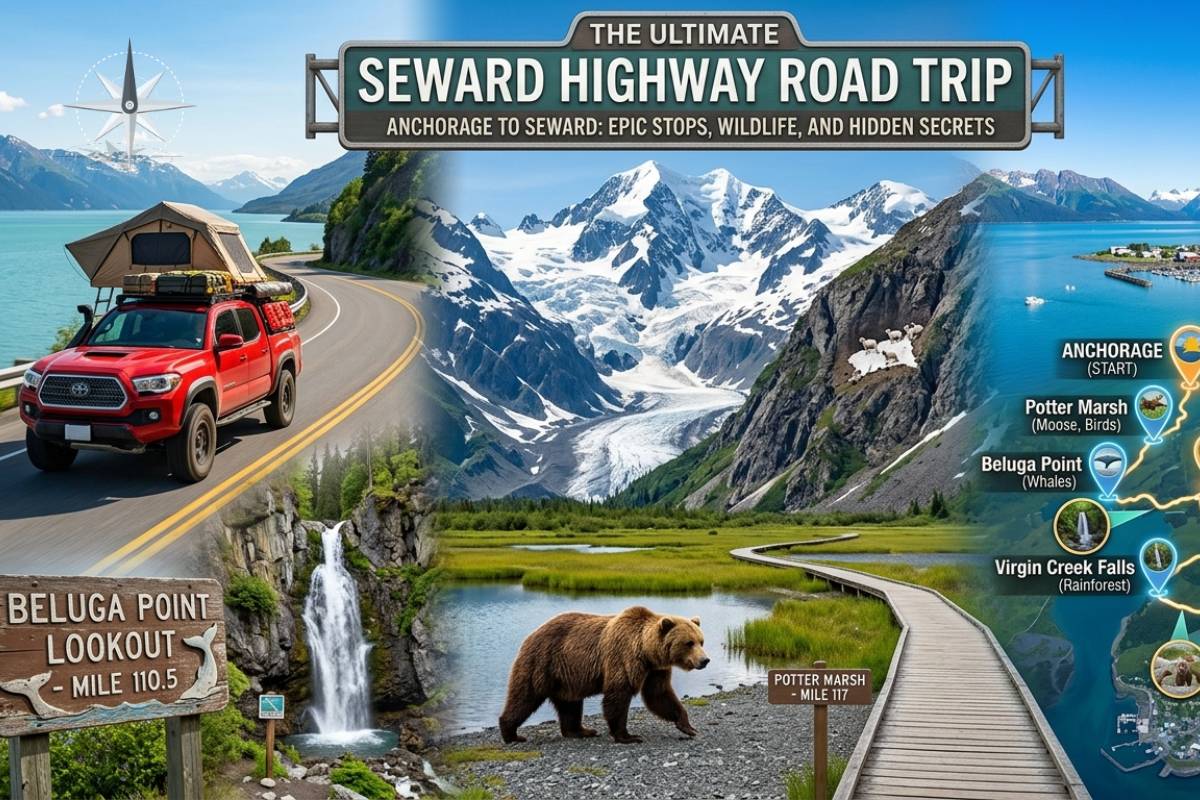
You earn Seward. After 127 miles of one of the most visually overwhelming drives in North America, you roll into a small harbor town tucked at the base of Marathon Mountain, and it feels exactly right.
Seward is not trying to be a tourist destination. It’s a working town that happens to sit next to a national park, a world-class glacier, and some of the best sportfishing in the country. That combination makes it one of the most satisfying places in Alaska to actually stop moving for a couple of days.
Two nights minimum. Seriously. One night goes to the national park cruise. The other should be left loose enough to follow whatever catches your attention. Browse vacation rentals and hotels in Seward before you finalize your trip. The good ones disappear fast in summer.
Best Things to Do in Seward Alaska
- Alaska SeaLife Center: Part research facility, part aquarium, completely worth it. Sea lions, puffins, seals, and otters in one of the few facilities where you can actually understand what you’re looking at and why it matters.
- Kenai Fjords National Park Glacier and Wildlife Cruise: Single-day and multi-day options, both excellent. Book in advance. This is the highlight of Seward for most people and it books out weeks ahead in July and August.
- Flightseeing Over Harding Icefield: The only way to grasp how enormous this icefield actually is. From the ground, you see one glacier. From the air, you see where it comes from.
- Exit Glacier: Ten minutes from town, free to enter, and one of the most accessible glaciers in North America. Go early morning before the tour buses arrive.
- Salmon and Halibut Fishing: Seward’s harbor runs full charters throughout summer. Half-day halibut trips are available most mornings. The fish are large and the crew generally knows what they’re doing.
The Exit Glacier is one of the only glaciers in Alaska you can reach by car and walk up to for free. It still somehow manages to feel uncrowded if you get there before 8am.
We arrived at first light and had the lower trail to ourselves for almost an hour. The upper Harding Icefield Trail is a different proposition entirely: 8.8 miles, 3,200 feet of elevation gain, six to seven hours round trip. It is a serious mountain hike, not a morning stroll. But the view at the top of an icefield that stretches beyond your line of sight is the kind of thing that reorients your sense of scale entirely. Bring layers, start early, and don’t underestimate it.
Best Time to Visit by Experience
| Experience | Best Month | Season | Notes |
| Beluga Whale Spotting | Mid-August to October | Late Summer / Fall | Peak: first week of September |
| Wildflower Blooms | June to July | Early Summer | Best along Portage Valley |
| Salmon Fishing | June to September | Summer | Species vary by month |
| Glacier Viewing | May to September | Summer | Exit and Portage Glaciers |
| Fall Foliage and Fewer Crowds | September to October | Fall | Quieter roads, vivid colors |
| Skiing at Alyeska Resort | December to March | Winter | Best powder in Southcentral Alaska |
| Aurora Borealis Viewing | October to March | Fall and Winter | Best away from city lights |
| Gold Panning at Crow Creek | May to September | Summer | Seasonal operation only |
Conclusion
Every mile of the seward highway road trip earns its place. Nothing on this route is filler.
Watch belugas from the road at Beluga Point. Pull salmon out of the Kenai and Russian Rivers. Pan for real gold in the Crow Creek Mine. Walk into the blue of Portage Valley on a trail nobody else took. Stand in Moose Pass and feel the quiet. Get on a boat in Seward and watch a humpback breach in front of a tidewater glacier.
This road has been waiting. Your only job now is to drive it.
Frequently Asked Questions
How long is the drive between Anchorage and Seward and is it easy?
The road is paved the whole way, well-maintained, and easy to navigate without any off-road experience. Pure drive time from Anchorage to Seward is about 2.5 to 3 hours.
The catch is that you won’t drive it in 2.5 hours. You’ll stop. A lot. Budget a full day at minimum, and ideally two if you want to do the stops justice rather than just check them off.
Fill up in Anchorage. Girdwood has a station but it’s often busy. Don’t leave your fuel situation to chance on this route.
What is the best time of year for a Seward Highway road trip?
Late May through early September is the sweet spot. Long daylight hours, wildflowers in bloom, wildlife active, and all attractions and trails open.
Fall, specifically September and October, is genuinely underrated. The crowds thin dramatically, the road feels like yours, and the autumn colors along the peninsula are stunning. Beluga whale sightings also peak in this window.
Winter is for experienced cold-weather travelers only. Snowfall is heavy, visibility can disappear fast, and several attractions close. If you go, use winter tires and watch the forecast obsessively.
Do I need entrance passes for attractions on the Seward Highway?
Most pullouts, viewpoints, and trails are completely free. The two main paid attractions are the Alaska Wildlife Conservation Center and Kenai Fjords National Park. Both are worth the entry fee.
Are there camping grounds along the Seward Highway?
Several, and they’re well-positioned near the main stops. Kenai Lake, Portage Valley, and Cooper Landing all have campgrounds and RV parks nearby.
Alaska’s weather is genuinely unpredictable even in summer. Make sure your family camping gear is rated for cold nights and sudden rain before you leave home.
Is the Seward Highway open all year round?
Yes, it stays open year-round. In winter though, it’s a different road entirely. Snowfall can be heavy, ice is common, and conditions can deteriorate fast.
If you’re traveling outside of summer, check the Alaska DOT road conditions before you leave, make sure your vehicle has appropriate winter tires, and tell someone your route and expected arrival time. This is not a road to take casually in January.